top of page


FÉLIX AGOSTINI
BIOGRAPHY
Félix Agostini was born in 1910 and displayed a talent for drawing from a young age. Agostini’s artistic inclinations led him to debut a career at the renowned printer Draeger in 1934. There, he created designs in the flourishing domain of advertisement for brands such as Peugeot while simultaneously turning out fabric patterns for the House of Chanel. Félix Agostini’s time at Draeger is formative : it represents a foothold into the rich artistic milieu of Art Deco Paris, surrounding the young artist with collaborators including Cassandre and Paul Iribe. In addition to this valuable introduction into the art world, Félix Agostini’s time at Draeger foreshadows his calling for the decorative arts; the young artist began creating unique custom lampshades.
In the following years, Félix Agostini opened up his own practice creating artworks in wrought iron and bronze and ceramic. The beginning of Agostini’s creative pursuits was marked by his collaboration with Diego Giacometti. Agostini would attest to this friendship and his wider admiration for the Giacometti brothers many years later through his homage to both Diego and Alberto Giacometti, a floor lamp entitled L’Échassier.
In 1955, Agostini began sculpting in plaster for the first time. These artworks, which were then cast in bronze and gilded, are those for which the artist is best known today. Agostini’s work was available during this period in two boutiques in Paris, first in the 14th arrondissement and later in the 8th arrondissement. The artist exhibited at the Galerie Cusin in Mougins for numerous summers. Agostini continued creating artwork until his death in 1980, at which point his body of work consisted of over 200 artworks. The Galerie Laurent Dubois has been collecting and exhibiting Félix Agostini’s artworks since 2009 and is known in Paris as one of the predominant purveyors of the artist.

L'Echassier Floor Lamp, circa 1960,
An Homage to the Giacometti Brothers
THE ARTIST'S ŒUVRE
Félix Agostini’s body of work is predominantly composed of artworks in gilt bronze. These artworks include, but are not limited to, tables, lamps, and sculptures. Félix Agostini’s minimalistic designs are crafted with both expression and precision. Paired with the materiality of his signature gilt bronze, Agostini’s artworks captivate the viewer.
The inspirations that mark the artist’s oeuvre can be traced through multiple veins. Namely, Agostini’s body of work attests to influences including the natural world, mythology, and the Orient.
THE NATURAL WORLD

Homme Fanal Table Lamp, circa 1962.
Félix Agostini’s stylised allusions to the natural world can be seen in both reference to animal figures and to flora and fauna. Artworks such as Antilope Table and his Squale Table Lamp capture the artist’s brilliant capacity for extracting a form, a gesture, from the animal world and transforming it into a work of art is both technically and artistically astounding. In parallel, a Pair of Table Lamps entitled Cocotte amuse the viewer through their sensitive whimsicality. In effect, a a cocotte, or chicken, is here rendered down to mere lines that evoke movement and personality.
The poetic Cactus Wall Sconce depicts a rigid cactus, almost like a lightning bolt, accompanied by its disassociated lampshade. The lampshade, designed by Agostini, is strikingly modern and can be seen as a sun that shines down on the gilt bronze wall sconce.
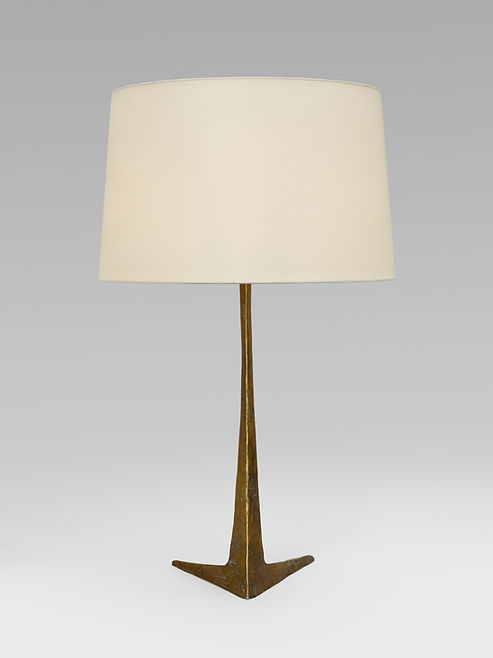

Pluton Table Lamp, circa 1960.
Squale Table Lamp, circa 1965.
TRIBUTE TO MYTH

Isphahan Floor Lamp, circa 1965.
AN IDEA OF THE ORIENT
SIMILAR ARTWORKS


bottom of page